
Career Stages in Construction: Are You Burned Out, or Simply Between Stages?

Why we can feel stuck, restless, or burned out when we might just be shifting into a different stage of our career.
Prefer listening instead of reading? Listen to the audio version of this article below:
I had no clue there were typical stages of a career. I figured you just dove in, set a blurry goal of where(ish) you’d like to be in 10 or 20 years, and then worked your butt off in that direction until you got there.
But what happens when you reach that goal…(and you’re not at retirement)? Is it everything you thought it would be? Is it enough to keep you in that same role, company, or even industry for the rest of your career?
That question has been rattling around in my mind a lot lately. Partly because I am in that shift (again) myself, and partly because I keep noticing it in other people in our industry.
Many of us my age have reached, or are reaching, the role, project, or level of responsibility that used to feel like the end goal. Executive leadership. Senior operations roles. Completing large, high-profile or complex projects. Bigger budgets, teams, pressure… And yet, for some of us, once we get there, something starts to feel off. Not necessarily wrong. Not necessarily broken. Just...different, and maybe a bit uncomfortable.
If you find yourself asking, Is this it? Is this what I will be doing for the rest of my career? What’s after this? you may be in that uncomfortable space between career stages. It can be confusing, irritating, and if you or your company do not recognize it, it can look an awful lot like burnout (or Rustout) when it may just be a craving for a professional or personal tune-up.
First, let me clarify Rustout vs. Burnout. In Making Construction Fun Again, I talk about how burnout comes from pushing too hard for too long, while rust-out shows up when we are no longer challenged, we feel stagnant, or the meaningful impact has become a bit blurry and out of focus. This is part of what makes this tricky. Not every tired, frustrated, restless leader is burned out. Some are. Some are indeed overworked and exhausted. But some may be between stages in their career and can’t put a finger on it to articulate the discomfort. These are very different problems that deserve different responses and solutions.
The Three Career Stages in Construction
In adult development and career development research, there are several theories that describe how people’s motivations, identity, and sense of contribution tend to evolve over time. As usual, this language leans toward academia vs how we talk, think and work in our industry, making it more difficult to apply it in our work. Part of what I try to do at Well Works is translate these ideas into practical, recognizable experiences within our industry.
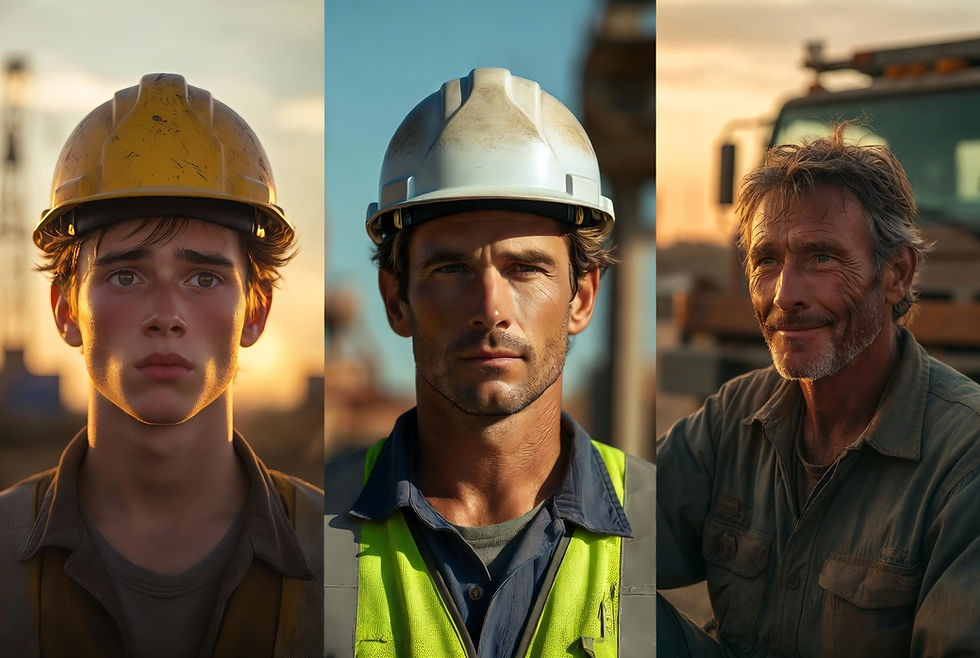
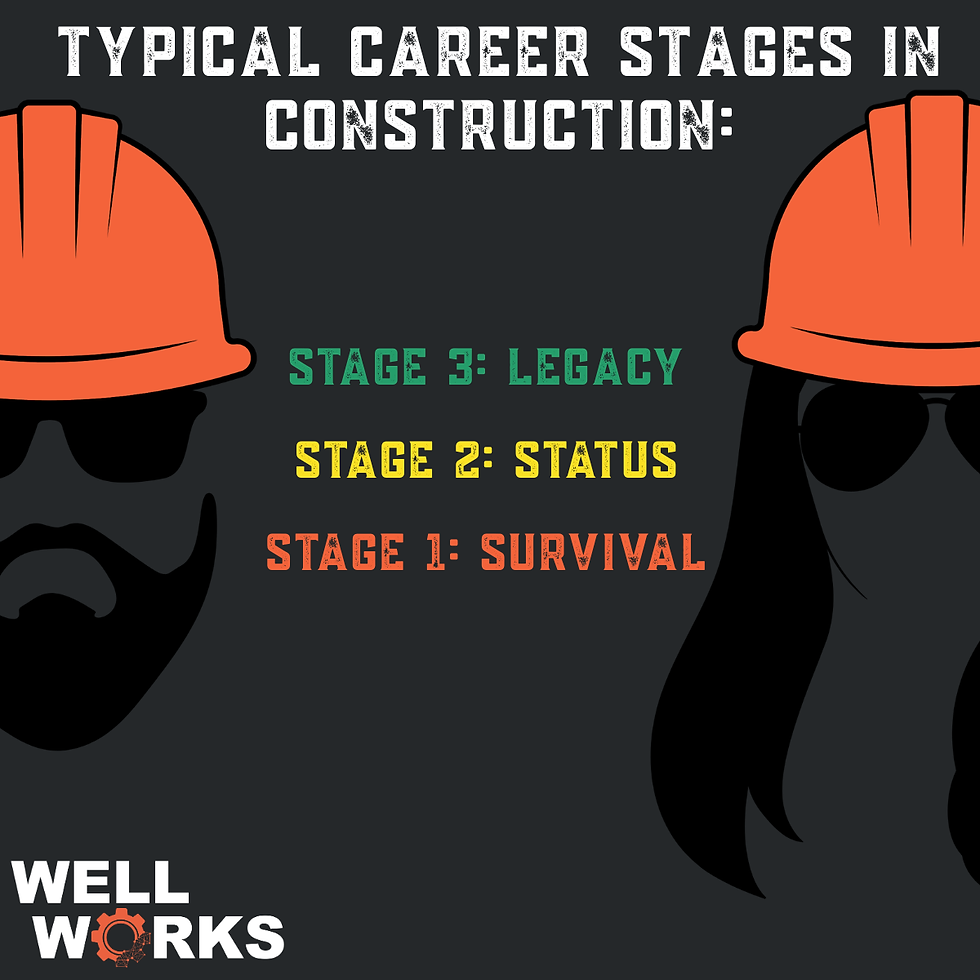
While there is no single universal model, much of the research points toward a similar pattern that, in construction terms, loosely looks like three career stages:
The first is proving yourself (think early career individuals, 0-6 years). I call this our survival stage. We are learning by doing, making mistakes, correcting them, navigating social dynamics, and building the basics that keep sites safe and moving. We are learning how construction works, why it works, what to do, what not to do, and how to earn trust. Feedback in this stage is short, direct, and concrete. “Set the elevation again.” “That layout is off.” “Re-write the RFI to include a proposed solution.” The focus here is learning the physical, technical, and management skills required to work in this industry and proving yourself worthy of the challenges and responsibility.
The second is building and delivering (think mid-career individuals, 5-15 years). This is what I call the status stage where many of us spend a large portion of our careers. We are still proving ourselves, but now we are also taking on bigger responsibilities, more complex challenges, and higher stakes. We are managing sequences, coordinating trades and contracts, owning delivery, carrying margin, leading teams, solving project problems, and building a reputation (for ourselves and the organization). This is where status, reliability, and results matter more and more. We are trying to grow our standing/status within a company, region, organization, or industry and continuing to build on that reputation. This is also the stage most organizations are designed to reward because it is visible and easier to measure.
The third is voice and contribution (think experienced individuals (13-40 years). I also call this the legacy stage. This is where the shift begins from personal production and proving ourselves to passing down knowledge and wisdom. People in this stage start caring more about mentoring, coaching, guiding, teaching, passing on traditions, and sharing what they have learned so the craft survives beyond their own contribution. The output is more mental than it is physical. THIS is where much of our aging industry is right now. Our bodies can’t necessarily handle the physical demands, the sleepless or restless nights solving problems, the long hours without adequate recharging (maybe I am only speaking for myself here). But this frequently comes up in conversations that sound something like this “I can build buildings in my sleep. I want something more.” This doesn’t mean they are above the work or think they are too good for it. It often means their relationship with the work is changing.
This shift is not just a feeling. As Erik Erikson put it, “Generativity is the central developmental task of middle adulthood. It focuses on concern for the next generation, stewardship, guardianship, provision of guidance, productivity, procreativity, and passing on cultural and family traditions.” He was also clear that “generativity is not about fame, personal glory, or power; instead it reaches toward a sense of meaning and purpose.” In construction terms, experienced builders move from chasing trophies, titles, and certificates of completion toward wanting to mentor, train, coach, and pass on their hard-earned knowledge of building and craft.
Not everyone follows this trajectory
Note that these typical career stages are helpful, but it is not a rigid rule or a guarantee for everyone.
Some people embrace and inherit this coaching, mentoring, and transfer of knowledge early in their careers. You know the type; they are the ones who stop and explain, who enjoy showing the right way the minute someone looks lost, who seem wired to help others learn long before they ever get a formal leadership title. These folks within our industry are gold. They speed up learning, raise standards, and prevent mistakes from multiplying. I hate to admit it, but I was not one of these people. Not because I didn’t want to be, but I was too caught up in learning to tread water myself in that survival mode to feel confident enough to coach someone else how to do it properly. I appreciate those who have the self-awareness and capacity to do this early in their careers (and do it well, I might add) because it does not come naturally to everyone. Trying to force it when it doesn’t come naturally to you may unintentionally come off arrogant, condescending or manipulative.
There are also people who hoard knowledge. They gatekeep because knowledge is power, right? Or because they tie identity to being the one who knows, the “go-to”. Sometimes it is fear of losing status or losing job security. Sometimes it is pride in craft. Sometimes it is just habit, because doing it yourself is faster and easier than slowing down to teach it. At the top end, that can show up as a kind of protective perfectionism: If I don’t do it, it will not be done right.
Both types need different support.
The natural teachers need time, structure, and support so their generosity does not burn them out (or they don’t come off the wrong way).
The knowledge hoarders need a different kind of leadership. They do not need to be shamed, but need practical reasons and structures that show them passing things on does not reduce their value but reinforces it.
Why being in between stages can feel like burnout
The discomfort that lives between stages gets ugly because several things collide at once.
First, the incentives and rewards rarely match the work. Most organizations measure margin, schedule, visible output, and production. Rarely do they recognize and reward the slow, quiet work of transferring knowledge, mentoring, or preventing a mistake before it happens. So the very work that may matter most in this next stage often looks invisible on paper.
Second, the skill sets are different. Doing a task and teaching a task are not the same thing. Running a job well and helping someone else understand how and why you run it well are two separate skills. Mentoring, coaching, and teaching are not automatic byproducts of experience. They need support, structure, and practice too. In the words of Maverick, “It’s not what I am, it’s who I am. How do I teach that?”
Third, being between stages wears us down. Trying to keep the job running while also mentoring and teaching is often double work. Research on status suggests that people who operate across groups and roles gain more perspective but also absorb more stress and experience lower well-being. In construction terms, you can have a superintendent who is respected on site, scrutinized in the office, relied on by the team, squeezed by the client, and trying to transfer knowledge on top of all that. How would this NOT show up as fatigue, defensiveness, frustration, or a drop in measurable output?
But small teaching moments add up. A superintendent spends an hour on a flashing detail. The pour is perfect. The extra time prevented rework or delay. But if no one recognizes that, and the only thing that shows up is when the super’s production numbers look “down,” then the conduit of knowledge gets crimped or cut off altogether. The organization tightens its measures, the client tightens the timelines, and the work that would actually strengthen the team gets abandoned (our current industry predicament).
This is why it can look like burnout. It is not always burnout. Sometimes it is a person trying to move from being the one who does it all to the one who helps others do it well (without relief of any current responsibilities and tasks).
Industry Application
We have to recognize and support people in this shift. And the solutions have to be practical.

First, make the work visible and paid. If you want someone to teach, coach, or mentor, allow time for it on the calendar and pay for it. It may be a “part of the job” but clearly indicate it in the job description and compensation package. Teaching and mentoring are not charity and they aren’t inherent. It is, though, great insurance against rework, accidents, turnover, and weak handoffs.
Second, treat early attempts as experiments. The first lesson, the first mentor conversation, the first training effort is probably not going to be great and there will be “failure”. That is fine, it’s actually good. If the company treats the first try like a pass-fail exam, people will stop trying altogether. We are human. It takes practice, patience and persistence.
Third, teach mentoring and coaching. Build and provide a quick “how-to” video, or reference sheet. Show people how to pick one teachable point instead of trying to dump everything they know at once. Teaching doesn’t come naturally with experience for most of us, and it is not simply an inherent part of the job. If you want people to pass things on, provide guidance, support, direction and “how to’s”.
Fourth, measure one honest outcome. Don’t overcomplicate it. Pick one thing. Did the apprentice complete the checklist without coming to you three times? Did the handoff include the three agreed-upon items? Did the repeat mistake get eliminated? Count it. Show the results. Make the contribution visible. Use an observation report if it helps you notice the small shifts.
Fifth, make space for the early mentors. Identify the people who already do this naturally and give them roles, guidance and support. They are amplifiers and influencers. Premade lesson plans, checklists, or SOPs can help them out from building these from scratch each time.
Sixth, handle the hoarders with a practical bargain. Do not shame them. Require a short co-teaching opportunity, a documentation step, creation or maintenance of the companies procedures, or a pairing where they demonstrate once and supervise the next couple of tries. Publicly recognize their expertise so they maintain status, and make the cost of hoarding clear by showing how lack of transfer creates rework or safety risk.
Seventh, build small, private practice groups. I wrote recently about legacy crews or Juntos. These give experienced people a place to test ideas, sharpen language, and get honest feedback. These groups work because they are small, trusted, and practical. They help good people get better at the people side of the work.
Why This Matters to Our Industry
My role in this industry is to build up and transfer these harder-to-teach essential skills of our industry. It’s a pathway I chose 6 years ago with Well Works. I frequently work with and support those within the industry who are in this later “legacy” stage — the ones with the experience, judgment, scars, and hard-earned perspective. I have been providing these skills for over 6 years, but now I want to refocus on my original intent when I started this company- more of a "teach a man to fish" approach, and ensure these individuals learn how to mentor, teach, transfer knowledge, inspire, and leave a legacy more effectively.

This is where I want to help. My next big project is around figuring out how to make those harder-to-teach people skills easier to pass on (not just be absorbed). I want there to be more resources, more practical guides, and more support for the people trying to share what they know. Whether someone is a crew lead, a general super, an aspiring PM, or someone just starting their own construction consulting or coaching business, they should not have to start from scratch. The point is to help people shine as they are — to share their own experiences, wisdom, and knowledge while also having premade content, research, and practical support on how adults best learn and receive information.
So, to those of you in this transition, or trying to navigate this “legacy stage” effectively: I am here to support you. We need your voice, your passion, and your wisdom.
Closing
These career shifts are real and many experienced people in construction go through them.
People in the industry need to know this exists so they can recognize it in themselves and do something constructive about it, preferably before they burn everything down or leave everything behind.
Leaders need to know these exist so they can support job crafting, mentoring, teaching, incentives, effective feedback and contribution opportunities instead of misreading the shift as a motivation problem.
Executives and C-suite leaders need to know this exists so they do not misinterpret people between stages as simply burned out, stale, or less valuable.
If we keep (intentionally or not) rewarding, supporting and focusing on only those in the Status, 2nd career stage, we are going to keep losing some of the most experienced, thoughtful, and knowledgeable people in the industry. And, as many of us know, we can replace bodies much easier than we can replace experience and wisdom.
It feels like something worth paying attention to.
Further reading & references
Erikson, E. H. (1982). The Life Cycle Completed.
Ibarra, H. (2003). Working Identity: Unconventional Strategies for Reinventing Your Career.
McAdams, D. P., & de St. Aubin, E. (1992). A theory of generativity and its assessment. Journal of Personality and Social Psychology, 62(6), 1003–1015.
Fernandes, C. R., Yu, S., Howell, T. M., Brooks, A. W., Kilduff, G. J., & Pettit, N. C. (2021). What is your status portfolio? Higher status variance across groups increases interpersonal helping but decreases intrapersonal well-being. Organizational Behavior and Human Decision Processes, 165, 56–75. https://doi.org/10.1016/j.obhdp.2021.04.002
Practical reads from Well Works: From Taverns to Trailers: Ben Franklin’s Junto (legacy crews), The Cost of Pushing Through: Protecting Leadership Capacity in Construction (leader maintenance), and Making Construction Fun Again.

Amy Powell — Founder & CEO, Well Works. I translate research into tactical leadership and communication tools for construction teams. Learn more about our work and programs at livingwellworks.org.


Comments